
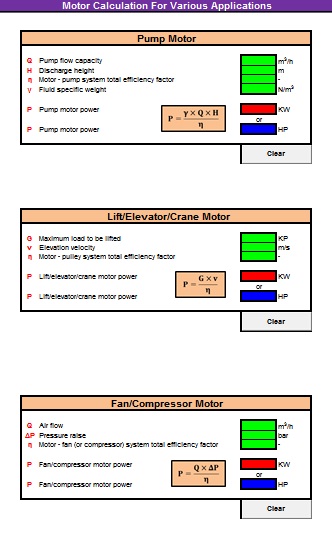
This workbook contains three short relationships that will help you find the motor power that is required for your application. I have included the following applications:
- Pump motors
- Lift/elevator/crane motors
- Fan/compressor motors
All the relationships are based on a total efficiency factor, which for most of the cases can be considered something between 0.5 and 0.7. Of course these relationships do not substitute an analytical calculation, but, could be useful for a quick reference.
The calculations are based on the following relationships:
1. Pump motors

where:
P: Pump motor power
γ: Fluid specific weight
Q: Pump flow capacity
H: Discharge height
η: Motor – pump system total efficiency factor
P: Pump motor power
γ: Fluid specific weight
Q: Pump flow capacity
H: Discharge height
η: Motor – pump system total efficiency factor
2. Lift/elevator/crane motors

where:
P: Lift/elevator/crane motor power
G: Maximum load to be lifted
v: Elevation velocity
η: Motor – pulley system total efficiency factor

P: Lift/elevator/crane motor power
G: Maximum load to be lifted
v: Elevation velocity
η: Motor – pulley system total efficiency factor
3. Fan/compressor motors
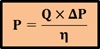
where:
P: Fan/compressor motor power
Q: Air flow
ΔP: Pressure raise
η: Motor – fan (or compressor) system total efficiency factor
If you have different units than those used in the relationships above you can download the units converter that I developed some months ago.
Download it from here

This file can be opened with Office 2007 or newer. Please, remember to enable macros before using the workbook.
